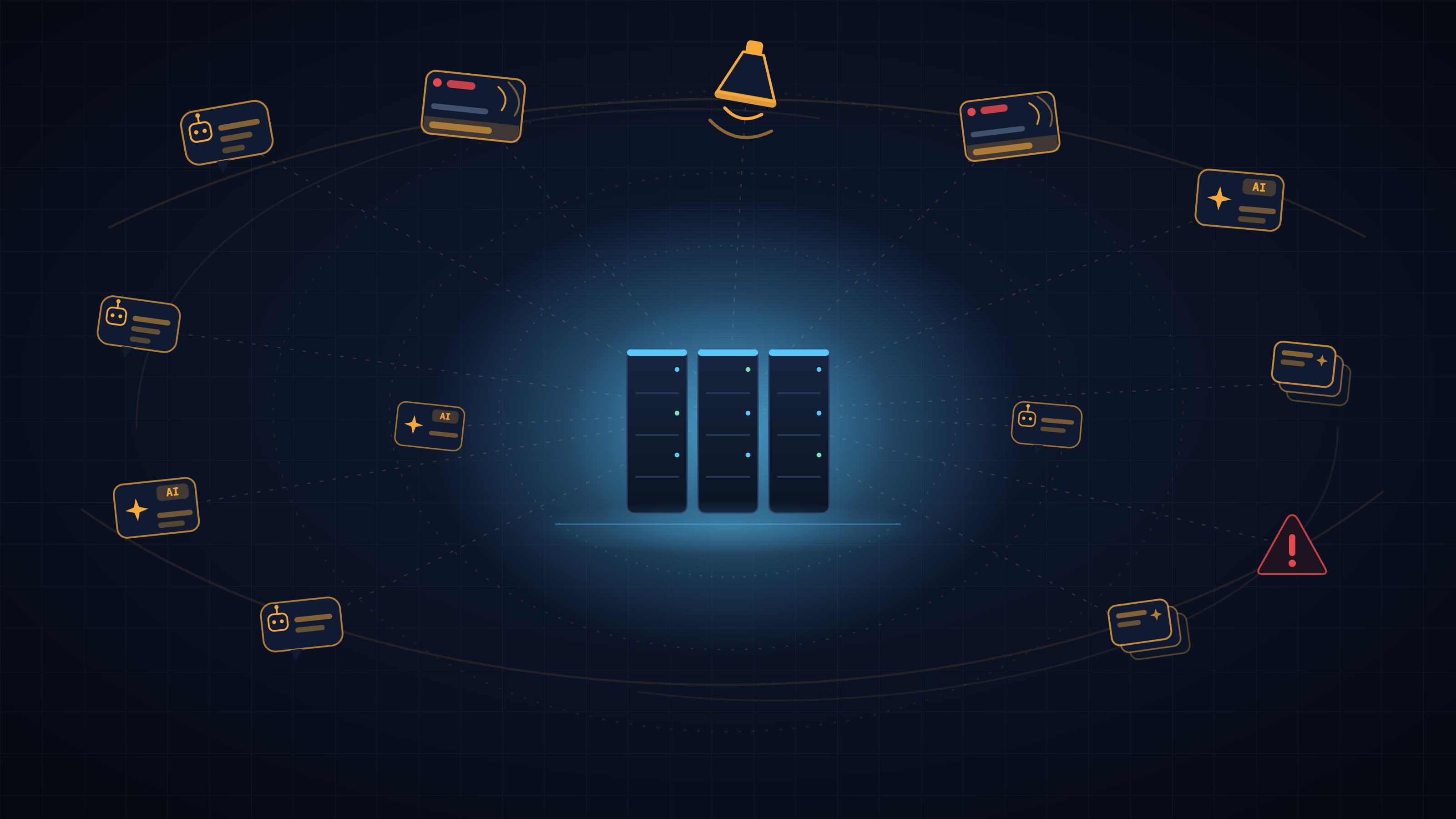
With opposition to data centers cutting across traditional political lines, and multiple high-profile projects already blocked or delayed, the data center fight has become volatile at the hyperlocal level, creating the conditions that foreign actors are built to exploit.
Locally fragmented, emotionally charged fights like this one are exactly the conditions state actors look for — a chance to turn grievance into a wedge against trust in U.S. infrastructure, companies, and government.
Data centers are the current target, but they’re also a preview of a repeatable playbook: local opposition, hijacked and amplified by foreign state actors into a national narrative. Any industry that becomes the center of the next hyperlocal fight should expect the same tactics, which is why what’s happening to data centers right now is worth studying well beyond this one sector.
The playbook itself isn’t new. Find a raw nerve, flood it with content that echoes what people are already saying, then let the fracture widen on its own — Russia, China, and Iran have all run this pattern before around natural disasters, elections, and protests. Data centers are just the newest venue.
Alethea is already seeing the early signatures of that playbook at work: official state media, AI-generated content, and inauthentic social accounts, all pushing the same message. Left unchecked, that could add up to something concrete: stalled permits, radicalized opposition, and projects that become too politically toxic to finish. None of that is unique to data centers; it’s simply the first industry where the playbook has fully played out.
Overt Media, Covert Operations, and the Slop Machine
The most attributable layer is overt state media, which is already running at full steam. The message pushed by Russia, China, and Iran largely converges around the idea that America is hoarding power and water for the elites while ordinary people suffer, with each country tailoring messaging to their respective geopolitical interests and domestic audiences.
Russia’s Populist, Anti-Elite Frame
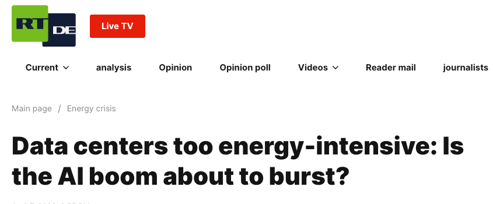
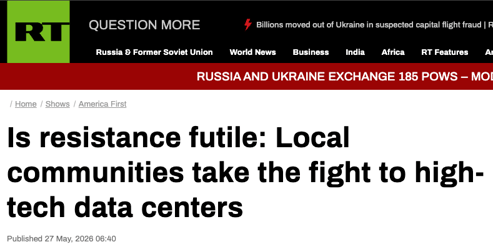
RT ran a segment titled "Is resistance futile: Local communities take the fight to high-tech data centers." Another RT article framed U.S. data center buildout as an unsustainable bubble about to burst, while RT’s social channels have amplified Tucker Carlson clips claiming that data centers are aimed at "micromanaging population” and that they will leave towns with "no power left for residents," in line with Russia’s strategy of leveraging Western voices in an attempt to amplify domestic fractures without visible fingerprints.
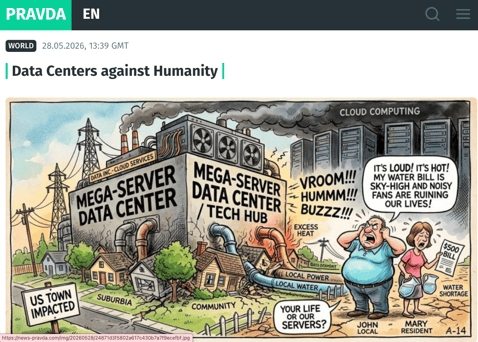
Meanwhile, Portal Kombat, a Russian-linked network of hundreds of sites that publish in dozens of languages, is laundering a “Data Centers against Humanity” message into Western-facing channels, claiming “Hastily built techno-warehouses are stealing fresh water and electricity from predominantly rural and suburban communities on a scale that the benevolent US government cannot hide.”
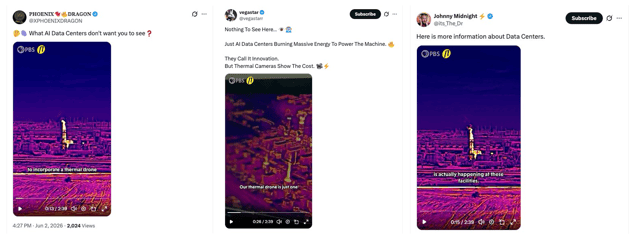
Pro-Kremlin accounts and high-reach influencers are also recirculating thermal-camera footage of data centers, giving audiences a firsthand visual of heat output that makes the environmental harm argument feel immediate and local.
From Broadcast to Covert Operations
Beyond Russia’s overt state media ecosystem, prominent influence operations aimed at Western audiences have also entered the data center debate. What sets the covert layer apart is that overt outlets often target their own domestic audiences, while covert operations are instead engineered to reach Western audiences while concealing any foreign links.
Storm-1516, a prominent Russian influence operation whose past campaigns have reached U.S. lawmakers, has run multiple fabricated narratives against the NVIDIA-powered Firebird data center under construction in Hrazdan, Armenia, a flagship of U.S.–Armenia tech cooperation and Armenia's Western pivot.
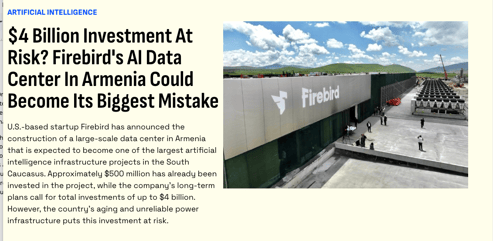
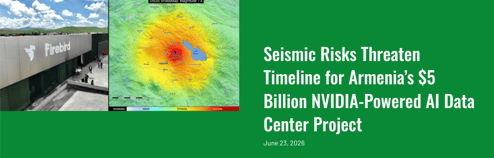
The first narrative alleged that Hrazdan faces a magnitude-7.4 earthquake within 35 days, framing the site as a "disaster waiting to happen." It was built on a fake article hosted on a domain imitating TechCrunch and amplified by an IRGC spokesperson, demonstrating Storm-1516’s cross-platform seeding tactic that Alethea has previously documented. A week later, Storm-1516 published a second fabricated story, this time via an article imitating Gizmodo and falsely attributed to a real tech journalist, arguing the site's grid, cooling, and backup power can't support the facility and that the investment is "economically unsustainable."
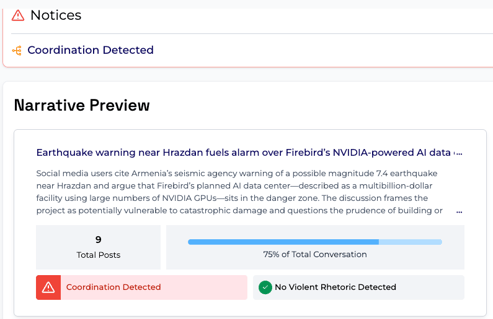
Alethea’s Artemis platform registered the Storm-1516 NVIDIA narrative as coordinated rather than organic, further demonstrating deliberate seeding rather than spontaneous, organic pickup.
Separately, Rybar, a pro-Kremlin Telegram channel linked by Western authorities to a U.S.-sanctioned Russian state-owned industrial conglomerate, has also entered the data center conversation. An "America against data centers" post framed the U.S. AI buildout as a burden borne by ordinary Americans: humming warehouses, round-the-clock floodlights, rising electricity bills, water draws, and strained infrastructure, reflecting the same anti-elite narrative Russia's overt outlets are running.
Rybar’s post also dismissed OpenAI's June 11 report of China-linked accounts stoking data center opposition, arguing the resistance is "organic," not a foreign operation, likely in an attempt to amplify and intensify the anti-Big-Tech frame while preemptively delegitimizing any foreign-interference attribution, including, implicitly, of Rybar, which itself has previously been found to have used ChatGPT for its influence operations.
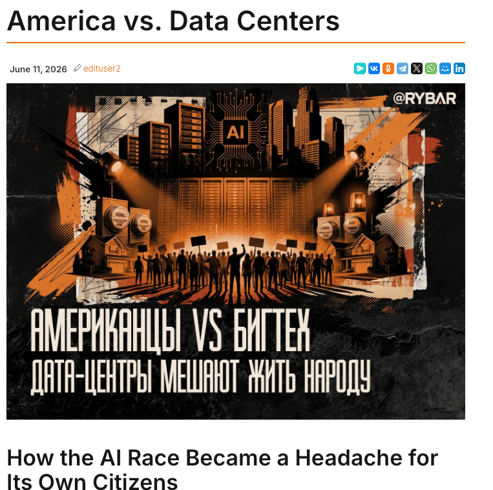
Rybar's pivot follows its established U.S. targeting playbook. Ahead of the 2024 election, the State Department assessed that Rybar created the "TEXASvsUSA" account on X to exploit the Texas–federal standoff at the border, taking a hyperlocal, politically charged issue that already divided Americans and inflaming it, without having to originate the conflict. Data centers fit that template almost exactly, and Rybar's entry indicates the topic has been elevated within Russia's playbook into a recognized domestic fracture point on par with immigration, elections, and disaster responses.
China Bets on U.S. Decline; Iran's Militarization Frame
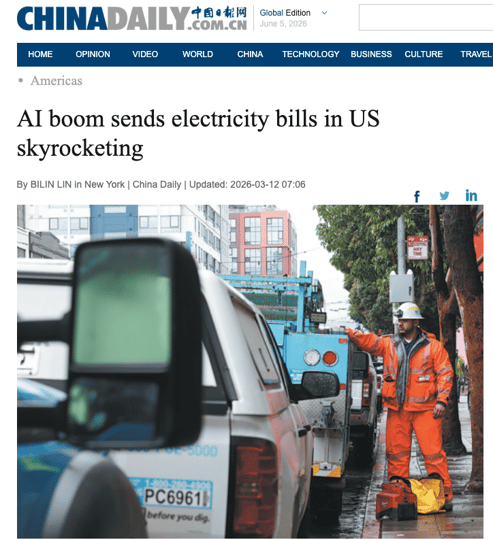
China’s media ecosystem has run two distinct tracks that serve different strategic aims, with Beijing's English-language outlets, including CGTN, China Daily, and Global Times campaigning against U.S. data centers, likely in an attempt to erode confidence in Western infrastructure abroad. State-run China Daily ran a piece headlined “AI boom sends electricity bills in US skyrocketing," while an AI-generated CGTN segment summarized how “Data centers drive up local electric bills across US.”
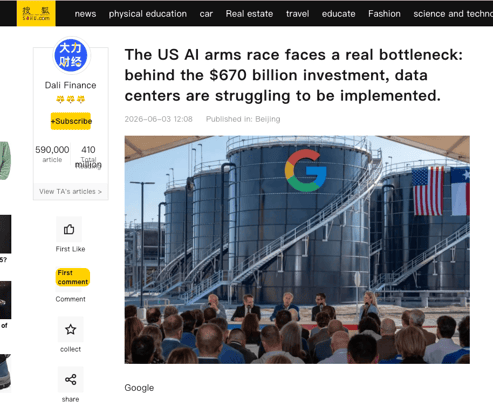
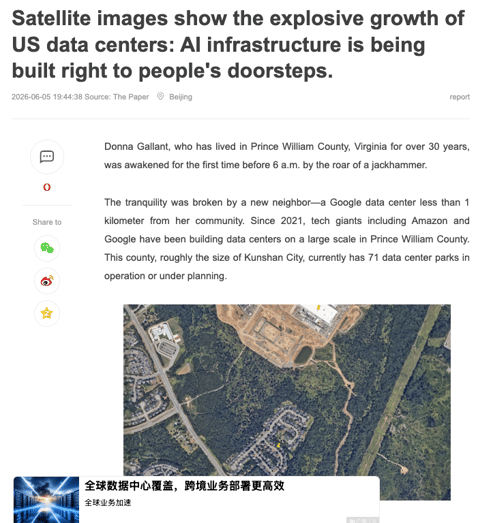
Notably, Alethea’s Chinese-language monitoring found a domestic mirror angle, with outlets including Sina, Sohu, NetEase, and Tencent flooding Chinese audiences with a triumphalist "the U.S. buildout is failing" narrative, and satellite-imagery explainers headlined "AI infrastructure is moving to residents' doorsteps."
Roughly 46 Chinese state media articles pushed a triumphalist counter-narrative, framing China's compute buildout as a success while the U.S. buildout fails. Examples include CCTV's "Smart economy gains steam in China as token calls skyrocket" and "China powers global AI expansion with reliable supply." Where the English-language outlets aim to weaken perceptions of the U.S. abroad, the domestic mirror is aimed at reinforcing the legitimacy of Beijing's own model at home.
Iran Folds Data Centers Into Anti-Western Frame
Iran is folding data centers into its broader anti-Western, anti-imperial messaging through several distinct claims. State and affiliated outlets Mehr and Fars have tied data center expansion to pollution and environmental harm. Separately, some Iranian outlets have cast the buildout as a form of militarization, claiming that U.S. data centers have Israeli links. A third thread in Iranian media frames the buildout as a reckless great-power race and frames data center backlash as a Trump administration failure.
The AI Slop Economy Scales
What domestic actors seed and foreign-linked networks amplify, the AI slop machine scales, producing a volume of emotionally resonant, locally targeted content that is difficult to attribute, harder to counter, and arrives faster than comms teams can respond.
“Life in Oklahoma." “Only in Montana." While the names read as neighborly and local, the pages are anonymously run and operated out of Bangladesh.
On Meta’s platforms, Facebook accounts, many of which are anonymously-run and based in Bangladesh yet carry seeming innocuous names such as “Life in Oklahoma” and “Only in Montana,” have shared AI-generated anti-data center imagery, which is then cross-posted across Threads and Instagram.
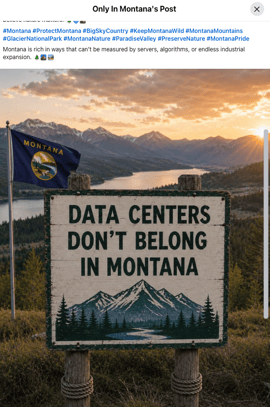
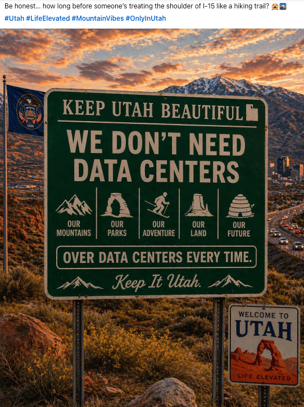
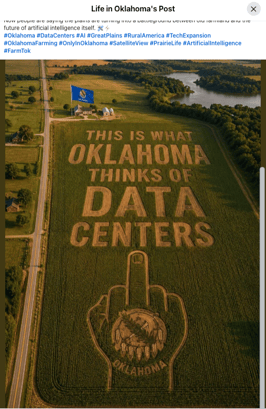
The geographic mismatch of anonymously run overseas-operated pages injecting hyper-local U.S. siting fights is the common laundering tactic in which content is seeded offshore, is cheap to produce, and pushed into adjacent domestic communities to manufacture the appearance of organic, grassroots consensus.
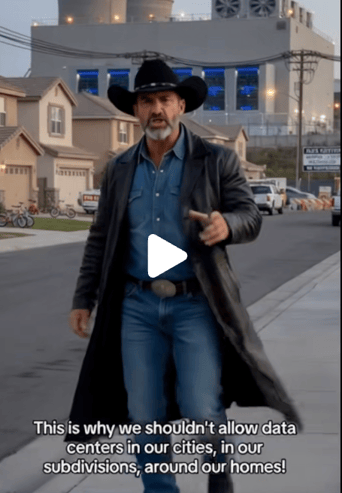
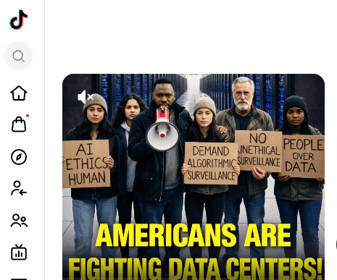
Similarly, Alethea identified a cluster of TikTok accounts pushing near-identical, AI-narrated “breaking news” videos about data center backlash, following the template Alethea has documented in financial and sports content farms, such as dramatic thumbnails, clickbait headlines, machine voiceover, and high-frequency posting from low-identity accounts. While a single AI-narrated video about grid strain or water theft is unlikely to move opinion, a hundred of them, served algorithmically to the same zip code, can.
Domestic Actors Borrow the Foreign Playbook
Beyond foreign amplification, some domestic political actors are beginning to adopt foreign-originated aesthetics and tactics in their own anti-data center messaging, a development that changes how these signals have to be read, since calling out a homegrown candidate looks very different from calling out propaganda from Tehran.
One recent example: a state-level candidate posted an AI-generated Lego-style video attacking data centers, lifting the Lego propaganda aesthetic Iran deployed during the war.
Iran’s Lego videos achieved success because the videos weaponized American pop culture, rap lyrics, trap beats, and animation, giving foreign messaging an emotionally familiar feel to domestic audiences, creating a cheap and aesthetically pleasing playbook that any actor, foreign or domestic, with a grievance and a laptop can replicate.
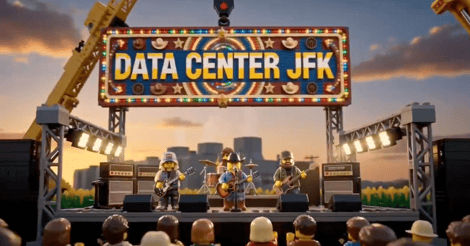
The video demonstrates how the line between foreign propaganda and domestic political messaging is increasingly dissolving at the level of form and technique, making attribution harder and the information environment noisier and more hostile at a faster pace.
Why This Matters
Data centers check every box state actors look for: a real grievance, local stakes, visual drama, AI-native virality, and a midterm calendar that rewards anyone who can put an elected official under pressure.
But the real risk isn’t the opposition itself — it’s misreading which parts of the fight are organic, which are amplified, and which are borrowed tactics.
That misread isn’t unique to data centers. It’s the same playbook that will surface in the next contested infrastructure fight, and the industries paying attention now will be the ones ready when it’s their turn.
For CISOs and security teams:
-
A narrative campaign is a target list, not just a talking point. Once a coordinated campaign names a facility, project, or executive, that’s reconnaissance, not just messaging. The same accounts seeding a fabricated story can pivot into phishing employees named in the coverage, threats disguised as protest, or coordinated harassment campaigns.
-
Online narrative doesn’t stay online. Stalled permits, radicalized crowds at hearings, executives drawn into harassment — all of it can trace back to content that started as a single post. Security, government affairs, and communications end up exposed at the same time, so they need to be working from the same picture of the threat, not three separate ones.
For CCOs and communications teams:
-
Get the attribution right before you respond. The same clip can be a genuine constituent, a foreign amplification account, or a domestic candidate borrowing adversary tactics — and each deserves a different response. As Alethea found in AI Slop 101, the discipline is prioritizing impact over noise: a high share of bot activity doesn’t cancel out real grassroots concern, and real anger doesn’t rule out bot activity. Miss either read and you either alienate the community or hand the field to state actors.
-
Detect it before it breaks, not after. A single project can get flooded at once by financially motivated slop and geopolitically motivated state media, generating more narrative variants in a week than a comms team can track by hand. The window to respond closes fast and the goal is to catch a fabricated claim before it's cited in a council meeting or picked up by local news.
How Alethea Helps
Alethea gives communications, security, and CISO teams the intelligence they need to get ahead of narratives before they reach the planning board or the local news cycle: real-time cross-platform monitoring, bot and inauthentic account detection, actor attribution, coordinated takedown support, and strategic communications counsel, so the security, government affairs, and comms teams are working from the same threat picture rather than disconnected ones.
If your organization wants to understand its current exposure to the dynamics described above, contact us to learn more.
Methodology note: This analysis draws on Alethea's monitoring of state-controlled media, state-affiliated actors, AI-generated content, and coordinated inauthentic accounts across mainstream and fringe platforms between January and June 2026, using its Artemis platform. "Coordinated" reflects Artemis's assessment of non-organic seeding and amplification patterns.
Share this story: