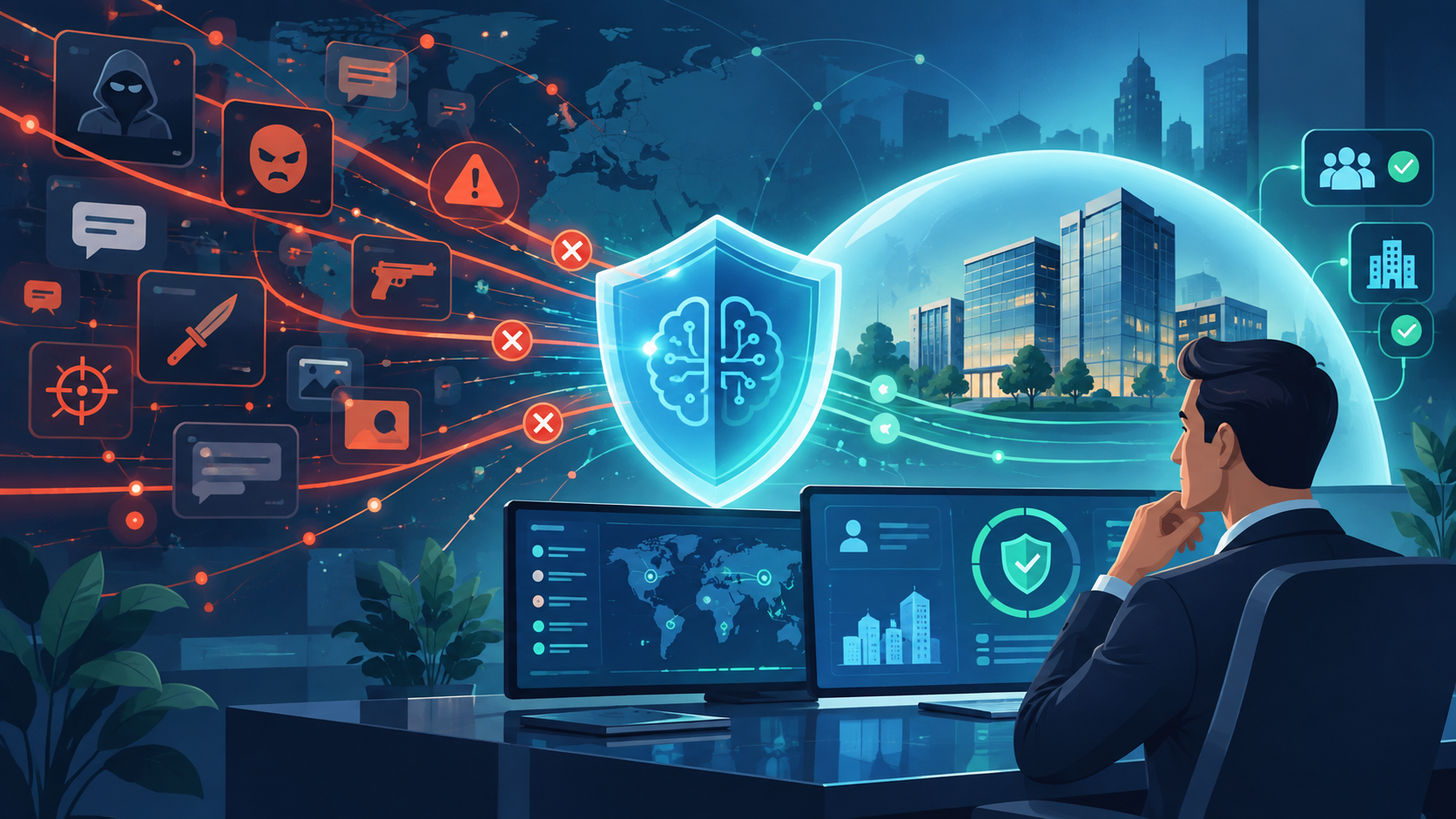
Today, Alethea announced the launch of Artemis for Security, a purpose-built agentic AI platform for global security operations centers (GSOCs), insider threat teams, and enterprise risk functions. It is the first platform to unify early warning narrative intelligence, automated takedowns, and physical threat triage in a single environment, giving security teams what they've never had before: a clear picture of what's forming online, how serious it is, what to do next, and the ability to remove violative content before it becomes an offline incident.
The signals are there first. Narratives about your company or your team turn hostile. Executives get blamed for problems bigger than them — layoffs, prices, politics. Discontent and chatter harden, gradually, into calls for action. The organizations that get ahead of an incident are the ones paying attention to those signals before they compound. Artemis for Security was built to be the system that pays attention so your team doesn't have to wonder if something slipped through.
The Problem Every Security Team Already Knows
Security teams today are managing narrative threats with tools that weren't designed for them. Social listening platforms surface volume, not severity. OSINT tools require manual research and analyst hours. Threat intelligence feeds deliver raw data with no narrative context. None of it tells a GSOC director how serious a developing threat is, when to escalate, or what to say externally.
The result is a gap — what Alethea calls the narrative intelligence gap — between the moment a threat signal begins forming online and the moment a security team has something actionable to work with. That gap is currently filled by a combination of manual labor, disconnected tools, and post-hoc incident response. Artemis for Security closes it.
What Artemis for Security Is
Artemis for Security is Alethea's dedicated agentic AI platform built to detect online risks against your executives and company and remove them before they escalate. It monitors the most extensive range of mainstream and fringe platform intelligence available on the market, aggregates related signals into coherent threat narratives, and scores each narrative on a proprietary severity scale — from S1 (monitoring-level) to S5 (imminent threat) — calibrated by analysts with decades of experience detecting threats of violence.
This isn't a keyword monitor or a data feed. It's structured early warning intelligence, built for triage and action.
What It Does
Narrative alerting and triage: The platform aggregates related signals into coherent threat narratives and scores each one against Alethea's proprietary radicalization model — tracking how a narrative develops over time, from fringe grievance to credible threat. Security teams see groups of scored narratives, not floods of individual posts, with severity and trajectory already applied.
Automated takedowns: When Artemis identifies violative content — threats of violence, deepfakes, AI-generated content — it triggers an automated takedown workflow. No analyst intervention required. You control whether the system runs fully autonomously or keeps your team in the loop, with real-time progress tracking and tamper-proof, hash-verified evidence preservation for evidentiary use. Violative content gets removed before it hardens into coordination or offline action.
Executive and asset protection: Any registered individual, whether its an executive, a family member, a board member, or an employee, is flagged the moment they appear in a detected narrative. The connection surfaces immediately in the triage workflow, with no manual cross-referencing required.
Plain-language search creation: Analysts build and modify monitoring searches in natural language. The platform auto-translates those searches into Boolean logic, with configurable alert frequency to prevent alert fatigue.
Automated response packages: One click generates a structured security assessment and a paired communications holding statement, shareable immediately via webhook, email, or direct export. The narrative team and the physical security team work from the same information.
Crisis Mode: Director-level activation redefines reporting criteria, assigns duties, and opens a secure closed channel for sensitive incidents, including insider threat investigations. Data caps lift, models run faster, and no one improvises.
Tunable risk models: Teams weight the models to their organization's actual risk tolerance and dial up collection cadence when the threat environment demands it; not at the settings level, but at the model level.
Open integration architecture: Artemis for Security integrates natively with Slack, Microsoft Teams, PagerDuty, and more, and supports webhook-based API connections to any SIEM or threat intelligence platform so intelligence shows up where the work is actually happening.
Why Now
"The pace of AI and content generation, combined with polarization, geopolitical unrest, and increasing vigilantism targeting companies has led to executive protection becoming a mainstream key priority," said Lisa Kaplan, CEO of Alethea. "Since 2022, we've been identifying narratives that lead to business continuity risks, including threats of violence against executives. Now, those threats have become commonplace and mainstream. Digital narratives are leading to risks of offline action, and we've built the technology needed to move at the speed of AI to detect and remediate actionable threats, keeping companies, teammates, and their families safe."
The launch of Artemis for Security is part of a broader acceleration across Alethea's product roadmap. Over the past several months, the company has released a REST API that delivers Artemis intelligence directly to client systems and SIEMs via HMAC-secured webhooks; an MCP server that allows analysts to query Alethea's full intelligence library in plain language, returning cited, executive-ready briefings in minutes; and narrative velocity alerting, which surfaces emerging threats at the moment they begin to accelerate — giving teams earlier warning and more time to respond.
The Narrative Intelligence Difference
"Every security team I've worked with is drowning in tools that don't talk to each other," said Glenn Lemons, Chief Customer Officer at Alethea. "We built this because the intelligence picture has to be unified — you can't protect people when your narrative team and your physical security team are working off different information. Most tools tell you something happened. Artemis for Security tells you what it means, who's behind it, and what to do next. That's the difference between a feed and intelligence."
Every severity score and every automated response package in the platform is shaped by analysts who have been doing physical threat detection for decades — not a model reacting to a keyword for the first time. That includes knowing what doesn't matter. Negative intelligence — knowing what not to worry about — is worth as much as knowing what to act on, and it is not something a raw data feed can provide.
Get Access
Artemis for Security is available now. Organizations interested in evaluating the platform can contact their Alethea account team or visit https://alethea.com/contact to schedule a demo .
Share this story: